What becomes possible when the most important work in the world is no longer starved for resources?
What happens when nonprofit organizations are no longer forced to fight for scraps, chase grants, or live from fundraiser to fundraiser—but are instead fueled by a new economic engine powerful enough to sustain their mission at scale?
This is the question at the heart of Causeism.
For generations, we have accepted a world where many of humanity’s greatest needs are either left to government bureaucracy, vulnerable to political cycles, or dependent on charitable giving that rises and falls with the mood of the moment. We have accepted a world where nonprofit organizations are asked to solve the most urgent human problems with the least reliable funding. We have normalized scarcity in the very sectors where abundance is needed most.
But what if that was never the best we could do?
What if the world’s most mission-driven organizations were funded, continuously and structurally, by the daily movement of the economy itself? What if every transaction—every product sold, every service rendered, every exchange of value—could help finance the future of human flourishing?
Now imagine what that world could look like.
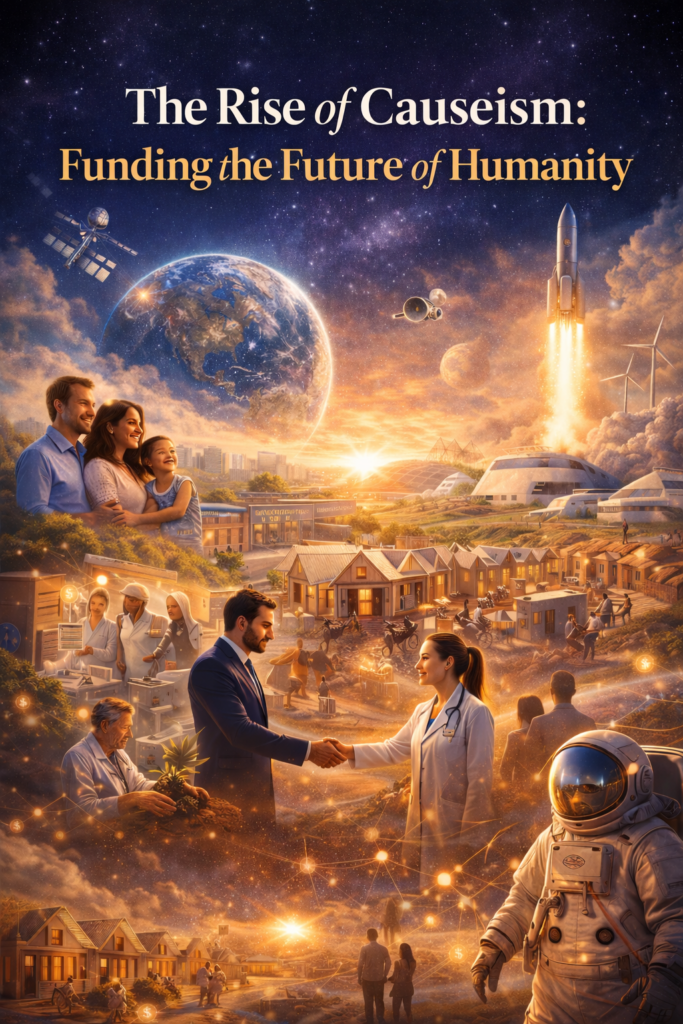
Imagine nonprofit healthcare systems so well funded that access to care is no longer tied to fear, debt, or employment. Imagine hospitals whose mission is not maximizing billing, but maximizing healing. Imagine nonprofit health networks that provide preventative care, mental healthcare, addiction recovery, elder care, and long-term treatment with the resources to reach every community that needs them. Imagine health insurance itself transformed—not as a product designed to protect margins, but as a nonprofit public-good infrastructure built to protect people. In a Cause Economy, healthcare could become one of the most generously resourced and most trusted systems in society.
Imagine homelessness no longer treated as an unsolvable social condition, but as a coordinated challenge met by permanently funded nonprofit housing coalitions. Imagine organizations with the ability to build beautiful, dignified, scalable communities—not temporary shelters, but real homes, transitional neighborhoods, supportive environments, and pathways back into economic and social stability. Imagine ending the cycle, not just managing the symptom.
Imagine hunger becoming obsolete. Imagine nonprofit food systems that do not merely respond to emergency need, but redesign regional access to nourishment. Farms, food distribution networks, local markets, school meal programs, nutrition education, soil regeneration, and logistics systems could all be connected through nonprofit ecosystems that are resourced year-round, not just during moments of crisis. Starvation does not persist because humanity lacks food. It persists because systems have failed to deliver it with justice, consistency, and care. Causeism could help build those systems.
Imagine disease confronted on a scale we have never seen before. Nonprofit research institutions could be financed not only by grants and government allocations, but by millions of everyday transactions woven into a larger cause economy. That means more research, faster breakthroughs, deeper collaboration, and less delay between discovery and delivery. Imagine entire nonprofit networks focused on curing rare diseases, preventing pandemics, funding regenerative medicine, and making life-saving treatments accessible to all—not because the market finally found them profitable, but because humanity decided they were worth solving.
And then imagine going even further.
Imagine the arts no longer forced to justify themselves at the margins of society. Imagine nonprofit orchestras, theaters, film institutes, design labs, museums, and digital storytelling platforms becoming some of the best-funded institutions on earth because we finally recognize that beauty, imagination, and culture are not luxuries—they are part of what makes civilization worth building. Imagine a world where creative genius from every neighborhood, every nation, and every generation is given room to bloom.
Imagine energy transformed through nonprofit innovation. Imagine vast nonprofit alliances building next-generation clean power grids, decentralized community energy systems, battery technology, and climate resilience infrastructure. Imagine environmental restoration not as a side effort, but as one of the central missions of a well-funded global economy aligned around healing the planet.
And yes—imagine even space travel.
Why should space remain the playground of the ultra-wealthy or the strategic ambition of nation-states alone? Imagine nonprofit space organizations dedicated not to private extraction or prestige, but to discovery, education, planetary defense, scientific collaboration, and the democratization of human exploration. Imagine a future where children from every background can see a pathway into the stars because humanity chose to fund wonder itself. Imagine nonprofit lunar laboratories, open-source orbital research, and missions designed for the advancement of all humankind. What if Causeism helped finance not only a better world—but humanity’s next chapter beyond it?
This is what becomes possible when we stop thinking of nonprofits as underfunded helpers on the sidelines and begin seeing them as civilization-building institutions.
The truth is that nonprofit organizations may be the natural stewards of many of humanity’s most important missions. They are uniquely positioned to serve without the distortion of pure profit motive. They can pursue long-term outcomes, protect human dignity, and keep purpose at the center of execution. But for them to operate at their full potential, they need something the current system rarely gives them: stable, recurring, scalable capital.
Causeism offers a path toward that future.
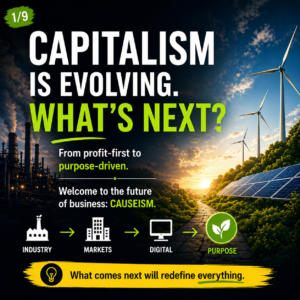
It creates a world where business does not compete with purpose, but funds it. Where commerce becomes a river feeding missions too important to be left under-resourced. Where the economy itself becomes an instrument of healing, creation, exploration, and hope.
This is bigger than charity. Bigger than philanthropy as we know it. Bigger than corporate social responsibility.
This is the possibility of redesigning the relationship between wealth and human progress.
A world where the cure for disease is not delayed by lack of funding.
A world where no child sleeps without shelter.
A world where no family is destroyed by medical debt.
A world where beauty is funded, discovery is shared, and the greatest human endeavors belong to everyone.
A world where humanity funds humanity.
That is the promise of Causeism.
If this vision stirs something in you—if you can see the outline of a better future and want to help build it—we invite you to learn more at Causeism.com.