
For decades, business and philanthropy have existed in parallel. Companies focused on generating profit. Non-profits focused on solving problems. When the two intersected, it was usually through donations, sponsorships, or short-term campaigns—well-meaning efforts, but ultimately separate from the core function of business itself.
According to Steve Down, that separation is no longer just outdated—it’s inefficient. It overlooks a fundamental shift happening in the global economy: non-profits, when aligned correctly, don’t simply receive value. They help create it.
This idea sits at the center of Causeism. It challenges the assumption that purpose lives outside of commerce and instead positions it as a driver within it. In this model, a non-profit is not downstream from success. It becomes part of the mechanism that generates it.
The shift begins with the consumer. Today’s buyer is not only comparing price and quality. They are asking, often quietly but consistently, what their purchase represents. That question carries real economic weight. When a product or service is connected to a cause that resonates, it gains meaning beyond its function. That meaning influences decisions. It builds preference. It creates loyalty. In a competitive marketplace, those factors are not abstract—they are measurable.
What Steve Down recognized is that the right non-profit partnership acts as a multiplier. It introduces trust in a way traditional marketing cannot. It transforms messaging into something more human, more grounded, and more believable. And it creates a level of differentiation that competitors cannot easily replicate. Features can be copied. Prices can be matched. But a deeply integrated purpose, lived out over time, becomes part of a company’s identity.
Still, most businesses approach this opportunity at the surface level. They treat non-profits as interchangeable, selecting causes based on convenience or optics rather than alignment. The result is predictable. The gesture may be appreciated, but it rarely changes behavior. The connection is thin, and without connection, there is no meaningful increase in value.
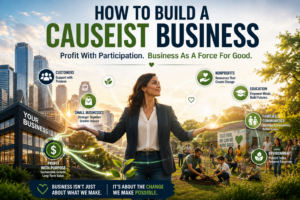
Causeism reframes this entirely by moving giving out of the margins and into the transaction itself. Instead of asking customers to contribute as an afterthought, it builds contribution into the purchase. Every transaction becomes a shared exchange between the customer, the business, and the cause. When done well, this does not feel like charity. It feels like participation. The customer is no longer a passive buyer. They are part of something larger than the product they are purchasing.
A global example brings this into focus. Imagine a company that integrates a partnership with Habitat for Humanity—an organization committed to building safe, stable housing for families around the world. Instead of relying on occasional donations, the business ties every transaction to that mission. A portion of each purchase contributes directly to building homes, strengthening communities, and creating long-term stability.
Now the purchase carries weight.
The customer is no longer just buying a product or service. They are participating in a tangible outcome. A home is built. A family gains security. A future changes. The impact is not distant or abstract—it is real, and it can be seen.
That shift transforms the relationship between all parties involved. The business is no longer just selling—it is standing for something globally relevant and deeply human. The customer is no longer just consuming—they are contributing to meaningful progress. And the non-profit is no longer positioned at the end of the transaction—it becomes part of the reason the transaction happens in the first place.
This is what it means for a non-profit to have market value.
As this model continues to evolve, non-profits begin to function as signals within the marketplace. They communicate what a company stands for, who it serves beyond profit, and why it exists at all. Consumers are increasingly using those signals to guide their decisions. In a crowded and competitive environment, clarity of purpose becomes a powerful advantage.
For generations, business has measured success with a simple equation: revenue minus cost equals profit. The work of Steve Down suggests that equation is incomplete. When purpose is integrated properly, it does not subtract from profit. It expands the total value being created—economically, socially, and emotionally.
The question for modern businesses is no longer whether they should support a non-profit. That conversation is already behind us. The real question is which partnership will elevate the value of what they offer.
Because in the world Steve Down is building through Causeism, non-profits are not on the sidelines of the economy.
They are becoming central to it.